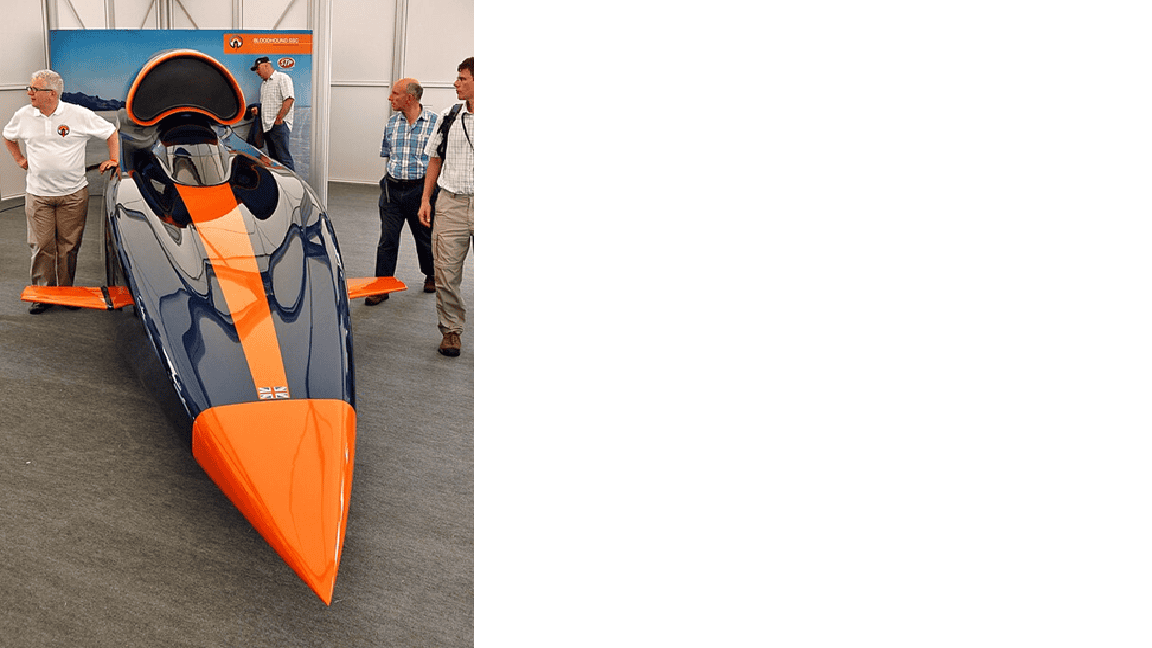
The quest for 1,000mph isn’t just about power; it’s about survival. The Bloodhound LSR (formerly SSC) is a masterclass in extreme engineering, designed to push a human being through the sound barrier on land. To achieve this, the team had to solve problems that usually only exist in the aerospace industry.
The Hybrid Propulsion Strategy: Two Stages to Supersonic
Getting a vehicle to 1,000mph requires a two-stage approach to thrust. You cannot simply use a rocket from zero, nor can a jet engine alone push you to Mach 1.3.
Stage 1: The Jet Engine (0 to ~650mph)
The car is powered by a Rolls-Royce Eurojet EJ200 afterburning turbofan—the same engine used in the Eurofighter Typhoon. In full reheat, this beast provides roughly 90kN of thrust. Its primary job is to accelerate the car to a speed where the rocket can become effective.
Stage 2: The Rocket Boost (~650mph to 1,000mph)
Once the vehicle hits the “transonic” window, a custom monopropellant rocket designed by Nammo kicks in. This rocket adds an additional 40kN of thrust, providing the final push needed to break the 1,000mph barrier.
Supersonic Aerodynamics: Fighting the Shockwave
At 1,000mph, the air doesn’t flow around the car; it piles up. As the vehicle approaches the speed of sound (approx. 767mph), it creates a bow shockwave. If this shockwave isn’t managed, the resulting pressure can create lift, effectively turning the car into an airplane—which is catastrophic when you’re trying to stay on the ground.
To combat this, the team used Computational Fluid Dynamics (CFD) and extensive stability modeling in partnership with Swansea University. The arrow-shaped profile is meticulously tuned to keep the center of pressure behind the center of gravity, ensuring the car remains pinned to the desert floor.
Extreme Wheels: Surviving 50,000g
Rubber tires would disintegrate instantly at 1,000mph. Instead, Bloodhound uses four 90cm diameter wheels forged from a high-strength aircraft-grade aluminium-zinc alloy.
- RPM: Designed to spin at up to 10,200 rpm.
- Force: The rims must resist centrifugal forces of up to 50,000g.
- Weight: Each wheel weighs 95kg, balancing strength with a need to minimize rotational inertia.
The Braking Sequence: From 1,000 to 0
Stopping a 6,400kg projectile moving at supersonic speeds is as dangerous as the acceleration. The braking is a three-stage process:
- Airbrakes: Deployed first to bleed off the initial supersonic speed and stabilize the vehicle.
- Parachutes: Deployed at approximately 650mph to provide massive drag and rapidly decelerate the car to subsonic speeds.
- Disc Brakes: Only once the vehicle is below 200mph do the traditional disc brakes engage to bring the car to a final halt.
Technical Specifications
| Feature | Specification |
|---|---|
| Target Speed | 1,000 mph (1,609 km/h) |
| Primary Engine | Rolls-Royce EJ200 (Jet) |
| Secondary Engine | Nammo Monopropellant Rocket |
| Wheel Material | Aluminium-Zinc Alloy |
| Total Weight (Fuelled) | ~6,422 kg |
Current Project Status (2026)
The Bloodhound project has faced significant financial hurdles, including bankruptcy in 2018 and the disruptions of the pandemic. The vehicle is currently housed at the Coventry Transport Museum. While the project remains “alive,” it is actively seeking new investment and a new driver to replace Andy Green for the final record-breaking attempt.
Frequently Asked Questions (FAQ)
How does Bloodhound reach 1,000mph?
It uses a two-stage propulsion system: a Rolls-Royce EJ200 jet engine for the initial acceleration and a Nammo rocket for the final push to supersonic speeds.
Why doesn’t the car fly away at high speeds?
The car’s aerodynamics are designed using CFD (Computational Fluid Dynamics) to manage the bow shockwave and ensure that the aerodynamic forces keep the vehicle stable and pressed to the ground.
What happens to the tires at 1,000mph?
Standard tires would burst. Bloodhound uses forged aluminium-zinc alloy wheels that can withstand extreme centrifugal forces of up to 50,000g.